Case study Fashion ecommerce
TY Dress Collection
A PHP/MySQL couture shop linking collection-led browsing to variants, cart snapshots, customer accounts, and order operations.
Problem statement
Preserve the identity of each fashion collection while keeping product choices, availability, checkout, and post-order operations understandable.
Proof / A quick look
See the product before the detail.


01 / Overview
The brief.
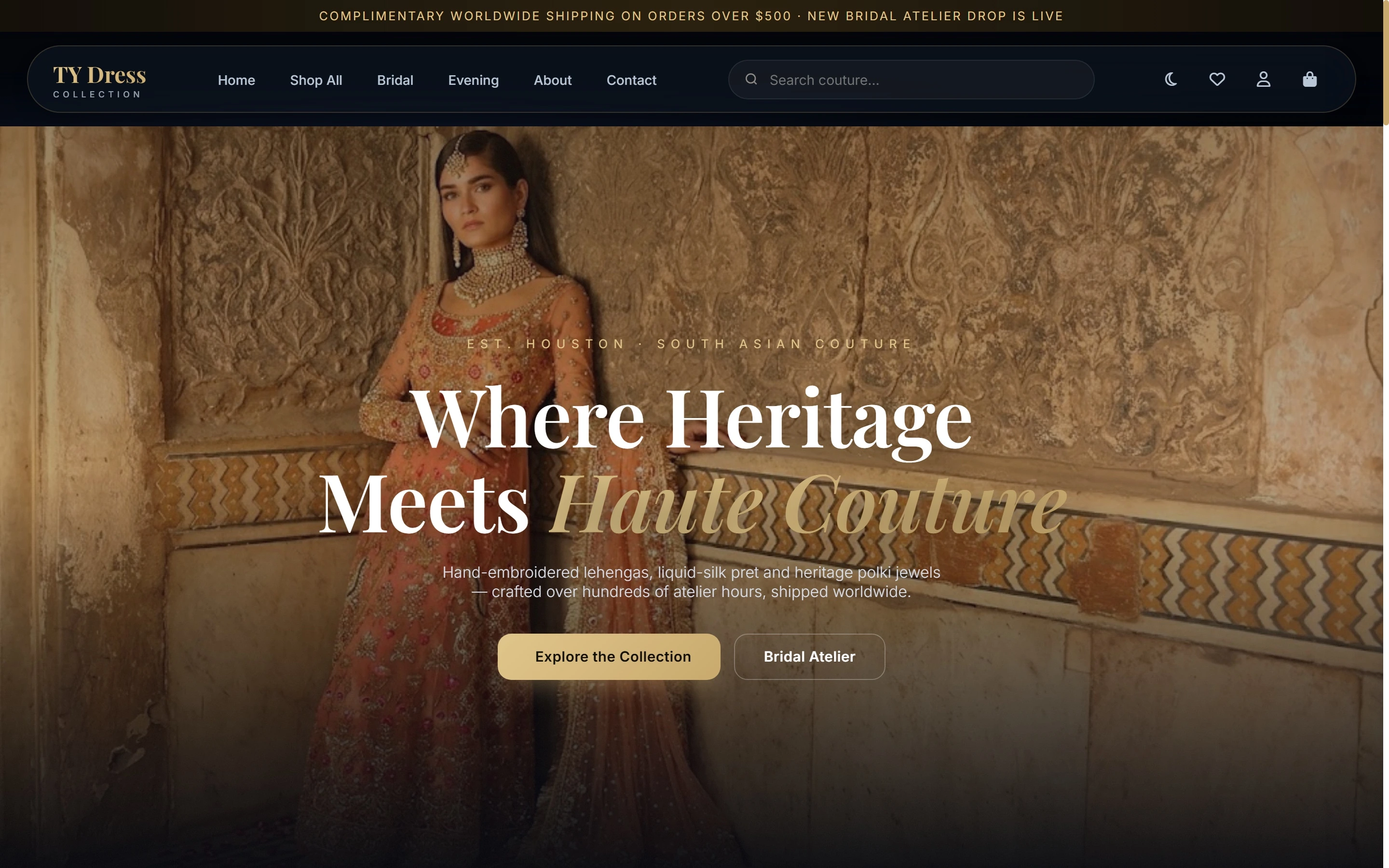
TY Dress Collection combines a fashion-house presentation with a custom commerce application. Pret, evening, bridal, jewels, and everyday pieces have distinct collection entry points, while the implementation carries visitors through products, variants, wishlist, cart, checkout, and tracking. My work spans that editorial storefront and its PHP/MySQL commerce layer, connecting product presentation, purchase details, customer accounts, and administration throughout the shopping journey.
02 / Situation
What was already true.
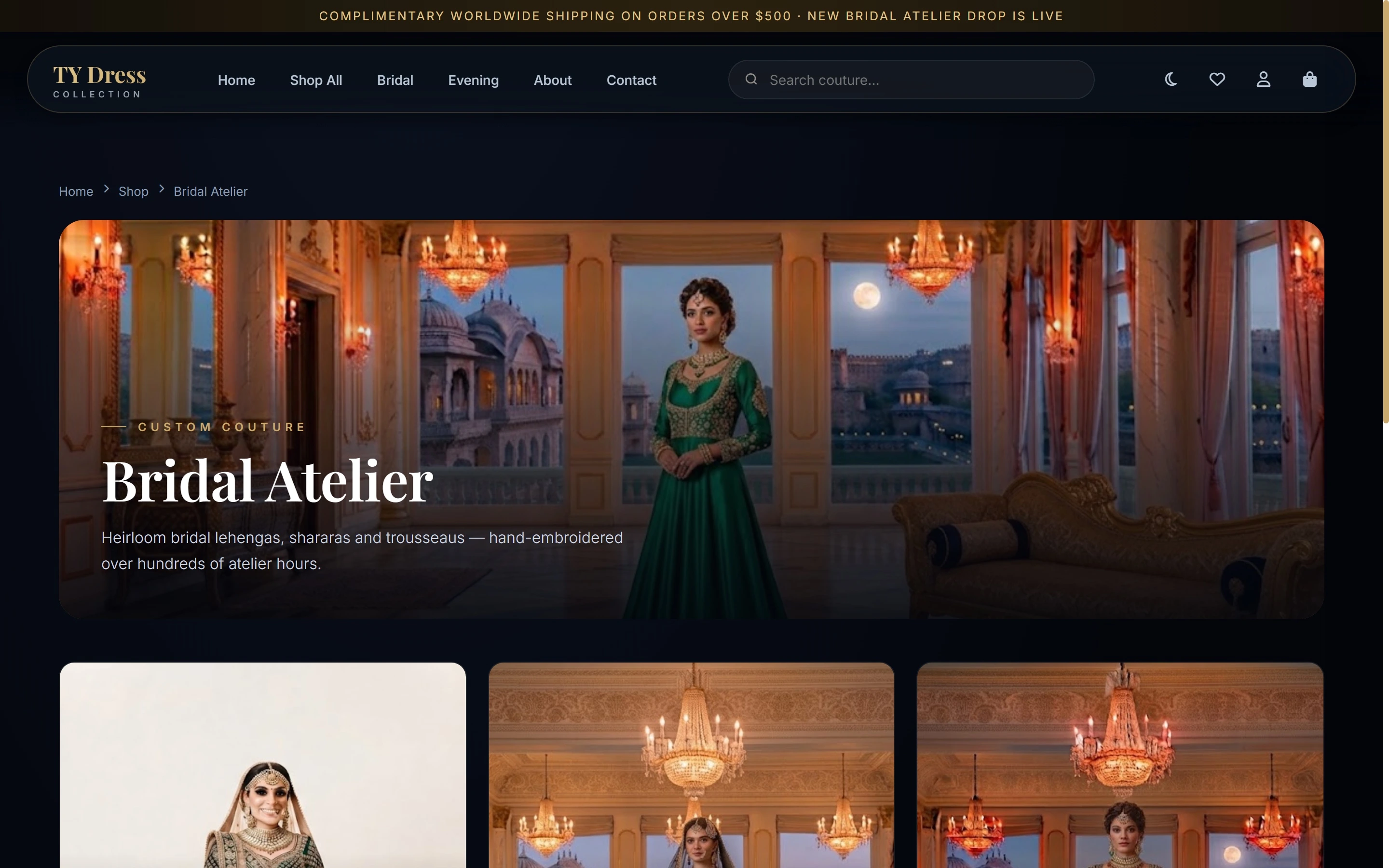
The storefront names collection worlds such as Pret Luxe, Evening Edit, Bridal Atelier, Heritage Jewels, Luxury Pret, and Modern Essentials. Customers also need concrete product information, a selected variant, a wishlist or bag, and a way to follow an order. Staff need to maintain the catalogue and handle the orders generated by that public journey.
03 / Tension
The competing needs.
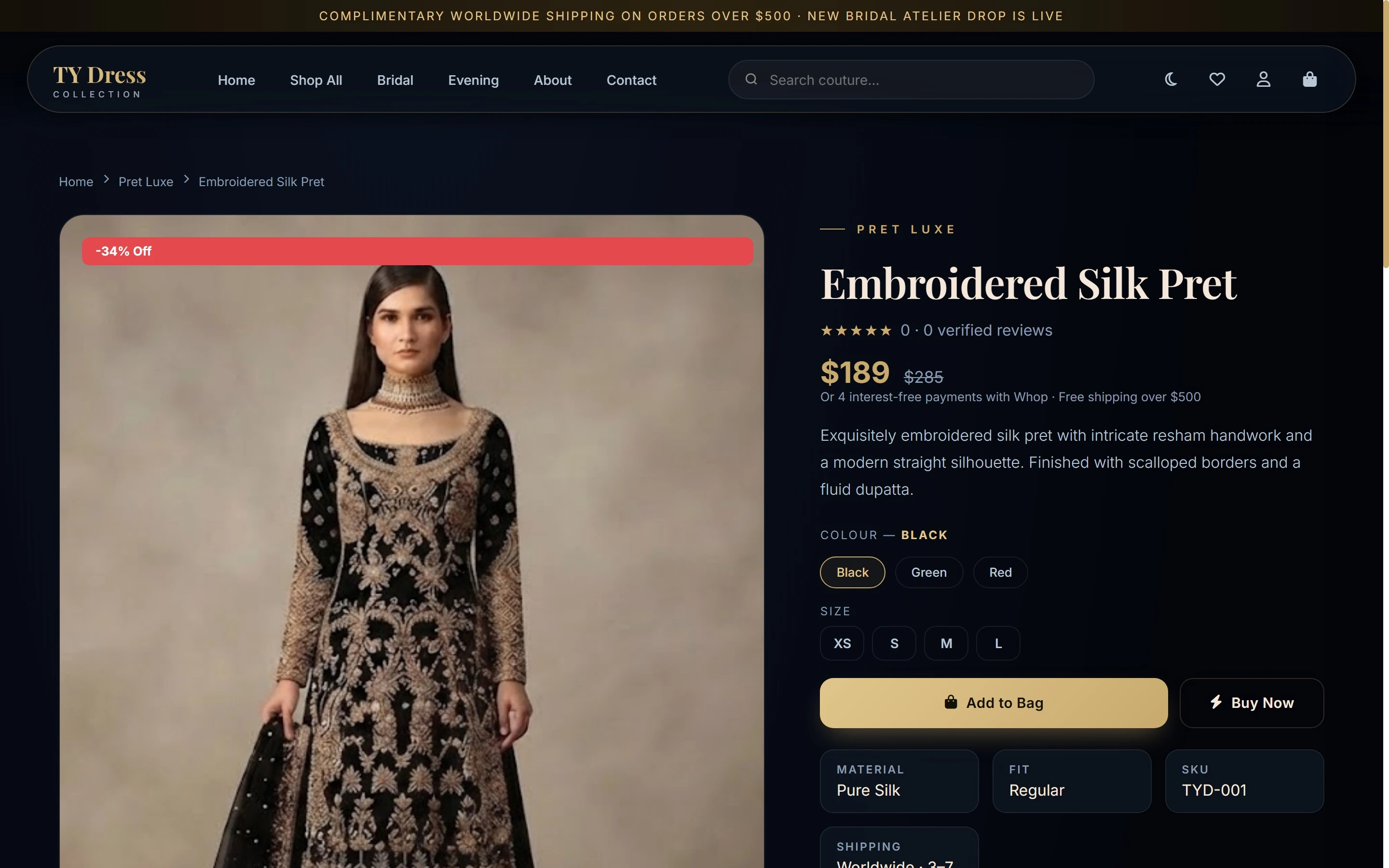
Editorial photography and pacing create a collection identity, while shoppers need price, availability, variant choices, and a clear next action. Behind the page, a cart item must become an order line with its own recorded details. Payment lifecycle, stock, coupons, and refunds add states that need to stay connected to both the customer’s journey and the administrative order view.
04 / Decision
The choice that set the shape.
Keep collection-first navigation as the editorial layer and make shopping tools a continuous second layer. Implement the commerce flow in the existing PHP/PDO application, with explicit order and payment lifecycle handling. Order-line snapshots retain the product and variant details at purchase, giving the customer and staff a lasting record of the selected items.
05 / Responsibilities
What I designed and built.
My scope includes collection and product presentation, responsive frontend behaviour, variant selection, wishlist and cart paths, guest and customer journeys, checkout integration, and order tracking. The implementation also covers administrative product, order, customer, coupon, message, and settings screens. On the commerce side, the work connects line-item snapshots, stock and coupon handling, and the Whop lifecycle and refund paths to the shop’s order records.
06 / Architecture
The implementation behind the interface.
The site is framework-free PHP with MySQL accessed through PDO; HTML, CSS, and vanilla JavaScript supply the browser experience. Shared include modules handle authentication and the commerce logic. includes/orders.php records cart-line snapshots and contains the order lifecycle, stock, coupon, and refund handling around the Whop integration. Payment webhooks provide a separate input to that lifecycle alongside checkout requests. Collection and product pages feed the cart, order records retain purchase details, and customer tracking and administration present the continuing order state.
07 / Access control
Who can do what.
includes/auth.php provides session-backed authentication, password hashing/verification, and current-user roles of customer or admin. admin/auth.php gates the administrative surface. Administrators have product, order, customer, coupon, message, and settings tools; the mobile admin surface is view-only. Customer accounts and guest shopping provide distinct routes through the storefront, with the customer/admin role model defining access to account and administrative work.
08 / System
How the pieces fit.
A shopper enters through a collection, opens a product, selects a variant, and saves it to a wishlist or cart. Guest and account paths lead into an order whose lines retain their purchase details. Checkout and webhook handling feed the order lifecycle; tracking supports the return visit. Administration maintains catalogue data and supports the commercial follow-up through order, customer, coupon, and message views.
09 / Evidence
What the shipped interface can show.
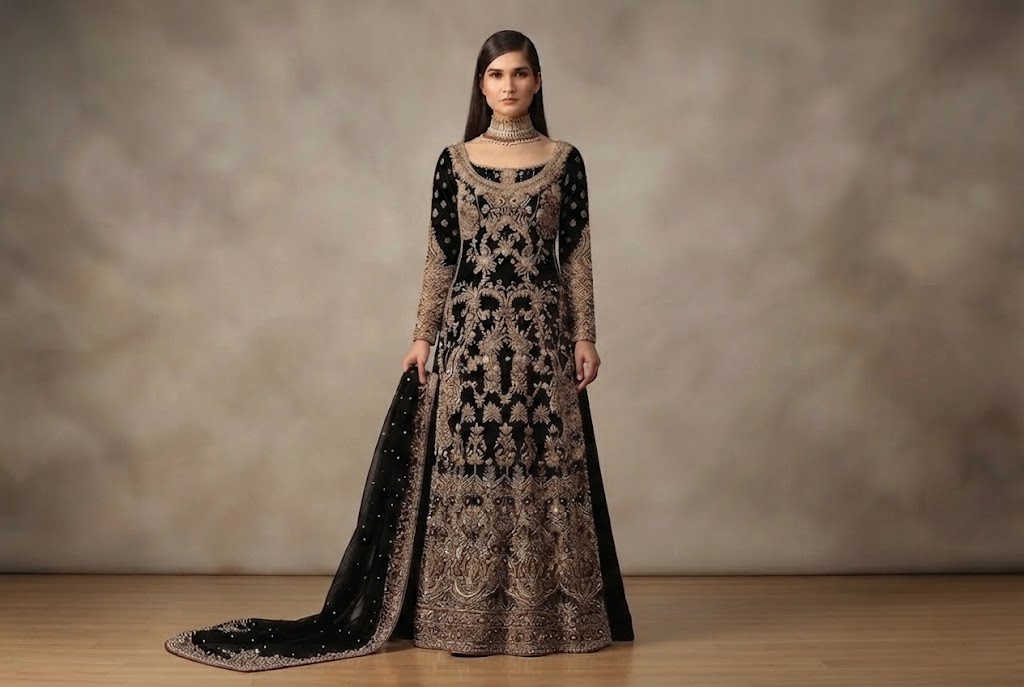
Collection pages and product variants lead into wishlist and cart controls, with customer accounts and tracking supporting the return visit. PHP/PDO modules connect those screens to order-line snapshots, customer/admin authentication, and the Whop integration’s webhook handling. Administrative views bring products, orders, customers, coupons, messages, and settings into the same commerce operation.
10 / Next iteration
The next question.
Trace a selected variant from collection browsing into cart, checkout, tracking, and the admin order view. Review sizing and delivery questions at the product stage, and separately exercise retry and webhook states against controlled test orders to understand the integration’s operational edge cases.
11 / Feature list
Features.
- Collection-first couture storefront
- Product and variant selection
- Wishlist and shopping cart
- Guest and customer account paths
- Order-line snapshots
- Whop integration and webhook handling
- Stock, coupon, and refund handling
- Order tracking
- Customer/admin roles
- View-only mobile administration
Gallery
Project images.
Open an image to view it. The full-image link still works when scripts are unavailable.